


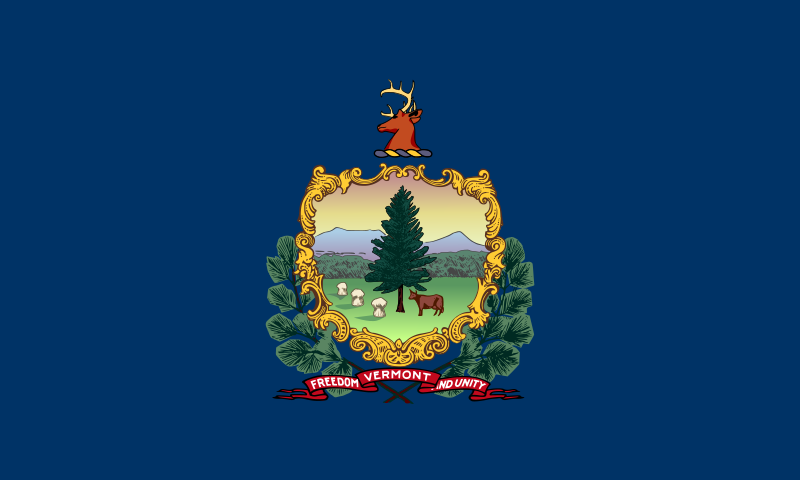
Vermont State Authority
Vermont State Authority is home to 647,106 residents with median household income $81,203.
Explore Vermont State Authority by County
Click any county to visit its landing page.
Vermont State: What It Is and Why It Matters
Vermont is the second-smallest state by population in the United States — the U.S. Census Bureau's 2020 decennial census counted 643,077 residents — yet it operates one of the more structurally intricate state government systems in the country, shaped by centuries of town-meeting democracy, a constitutionally distinct legal tradition, and land-use law that most states have simply never attempted. This page covers what Vermont's governmental and civic structure actually is, how it functions as an operational system, and why the details matter to anyone living, working, or doing business inside its borders. The content library here spans 86 published pages covering everything from individual counties and municipalities to state agencies, environmental law, and election rules — a reference architecture designed for depth, not just orientation.
Scope and definition
Vermont became the 14th state admitted to the Union in 1791, the first state added after the original 13 colonies, and its state constitution — originally adopted in 1777 — predates federal statehood and retains language that shapes how government authority is structured at every level. That constitutional foundation matters because Vermont's system is not simply a scaled-down replica of federal governance. It is genuinely its own architecture.
The state is organized into 14 counties: Addison, Bennington, Caledonia, Chittenden, Essex, Franklin, Grand Isle, Lamoille, Orange, Orleans, Rutland, Washington, Windham, and Windsor. Counties in Vermont function differently than in many other states — they are primarily judicial districts rather than administrative units with independent executive authority. The real unit of local self-governance is the town, and Vermont has 237 of them. That distinction is not merely academic. It explains why so much civic decision-making in Vermont happens at the selectboard level rather than through county commissioners.
Scope and coverage note: This site addresses Vermont state government, its 14 counties, named municipalities, and the agencies and bodies created under Vermont law. Federal law governs where it preempts state authority — particularly in areas like immigration, interstate commerce, and federal benefits programs. Tribal governance, federal land administration within Vermont, and purely private legal matters between parties fall outside the scope of this reference. Neighboring states' laws (New Hampshire, Massachusetts, New York) are not covered here, even where they interact with Vermont jurisdictions at border crossings or shared waterways.
Why this matters operationally
The practical reason to understand Vermont's governmental structure is that it is unusually consequential for daily life. Vermont's Act 250 — the land use and development control law passed in 1970 — means that construction projects above defined thresholds require permits that don't exist in most states. The Vermont Agency of Natural Resources administers much of this alongside the Environmental Division of Vermont Superior Court, and the permitting criteria include 10 distinct review standards ranging from water quality to aesthetics and community character.
Tax policy operates through the Vermont Department of Taxes, which administers one of the more complex state income tax structures in New England, including its own capital gains treatment and a property transfer tax that applies to most real estate transactions. The Vermont Department of Financial Regulation oversees banking, insurance, and securities — a consolidated regulatory body that combines functions separated across multiple agencies in larger states.
For those navigating civic or legal questions about Vermont's systems, the Vermont State: Frequently Asked Questions page addresses the most common points of confusion about jurisdiction, agency authority, and where state law ends and federal law begins.
Vermont's connection to the broader national authority reference network is maintained through United States Authority, which provides the overarching framework within which state-level resources like this one operate.
What the system includes
Vermont state government is organized across three constitutional branches, a network of independent agencies, and a quasi-judicial administrative apparatus that handles licensing, permitting, and regulatory appeals.
The legislative branch — the Vermont General Assembly — consists of a 150-member House of Representatives and a 30-member Senate, making it one of the larger state legislatures relative to population. The executive branch is headed by a Governor whose office coordinates 6 principal agencies: Transportation, Education, Natural Resources, Human Services, Commerce and Community Development, and Agriculture, Food and Markets. Each agency contains subordinate departments — the Department of Health under Human Services, for instance, or the Department of Motor Vehicles under Transportation.
The judicial branch is anchored by the Vermont Supreme Court and organized through the Superior Court system, which has Civil, Criminal, Family, and Environmental Divisions operating in each county. Vermont does not have a separate intermediate appellate court, which means the Supreme Court hears appeals directly from Superior Court in most cases — a structural choice with real implications for how long legal proceedings take and how legal precedent develops.
For a comprehensive look at how Vermont's government authority intersects with local governance, Vermont Government Authority provides detailed coverage of the state's institutional framework, including agency functions, legislative processes, and civic accountability mechanisms.
Core moving parts
Understanding Vermont's system requires tracking four distinct layers that interact constantly:
-
State statutes — codified in the Vermont Statutes Annotated, the primary body of Vermont law, organized by title and chapter and publicly searchable through the legislature's official portal.
-
Administrative rules — agency-level regulations that implement statutes, promulgated through a formal rulemaking process and carrying the force of law.
-
Local government authority — exercised primarily through town selectboards, school boards operating through supervisory unions, and special districts handling fire protection and utilities.
-
Regional planning structures — Vermont's 11 regional planning commissions coordinate land use, transportation, and economic development across county lines, filling a coordination role that counties themselves don't formally hold.
The county structure threads through all of this as the unit of judicial administration. Addison County and Bennington County each anchor distinct regional economies — dairy farming and outdoor recreation, respectively — while sharing the same basic Superior Court framework. Caledonia County in the Northeast Kingdom operates under the same state statutes as Chittenden County, Vermont's most populous county and the home of Burlington, but the demographic and economic contexts are so different they might as well be separate states in practical terms.
Essex County is the least populous county in Vermont — and one of the least populous counties in the entire northeastern United States — while Franklin County near the Canadian border hosts a mix of agricultural industry and interstate commerce that makes its regulatory environment distinct from Vermont's more interior regions.
What holds all of it together is a constitutional structure that places unusual weight on local deliberation, environmental stewardship codified into law, and a legislature that meets in Montpelier — a state capital with a population of roughly 8,000, the smallest state capital in the country by population — and somehow manages to govern a state that punches well above its size in policy innovation, environmental regulation, and civic participation rates.
Browse Counties
- Washington County (4,165)
- Franklin County (2,732)
- Orleans County (848)
- Essex County (698)
- Chittenden County (675)
- Bennington County (587)
- Grand Isle County (586)
- Lamoille County (434)
- Addison County (390)
- Orange County (339)
- Rutland County (166)
- Windham County (152)
- Caledonia County (141)
- Windsor County (108)
All Counties
Federal Disaster Declarations (44)
Source: FEMA OpenFEMA v2 DisasterDeclarationsSummaries
Codes & laws coverage
State statutes & administrative code
10 / 10
categories with corpus rows (100% of applicable) · known: Agency Guidance, Attorney General Opinions, Constitution & Foundation, Court Decisions, Federal Notices & Orders (+5 more) · full breakdown →
Laws & Codes
Live from our ingestion pipeline; new content appears within minutes of fetch.
- 13 V.S.A. § 701 Penalty A person who is a common barrator shall be fined not more than $50 · source
- 13 V.S.A. § 608 Assault and robbery (a) A person who assaults another and robs, steals, or takes from his or her person or in his or her presence money or o · source
- 13 V.S.A. § 601 · source
- 13 V.S.A. § 509 Attempts The placing or distributing of any inflammable, explosive, or combustible material or substance, or any device, in any building or · source
- 13 V.S.A. § 508 Setting fires A person who enters upon lands of another and sets a fire that causes damage shall be imprisoned not more than 60 days nor les · source
- 13 V.S.A. § 507 Burning forests A person who willfully and maliciously sets on fire, or causes to be set on fire, woods or forest, so as to occasion injury · source
- 13 V.S.A. § 506 Burning to defraud insurer A person who willfully and with intent to injure or defraud the insurer sets fire to or burns or attempts so to d · source
- 13 V.S.A. § 505 Fourth degree arson A person who willfully and maliciously attempts to set fire to or willfully and maliciously attempts to burn or to aid, · source
- 13 V.S.A. § 504 Third degree arson A person who willfully and maliciously sets fire to or burns or causes to be burned, or who willfully and maliciously aid · source
- 13 V.S.A. § 503 Second degree arson A person who willfully and maliciously sets fire to or burns or causes to be burned, or who willfully and maliciously ai · source